Gram Panchayat Balaghatta, Mandya District, Karnataka
Retrofitting Vernacular
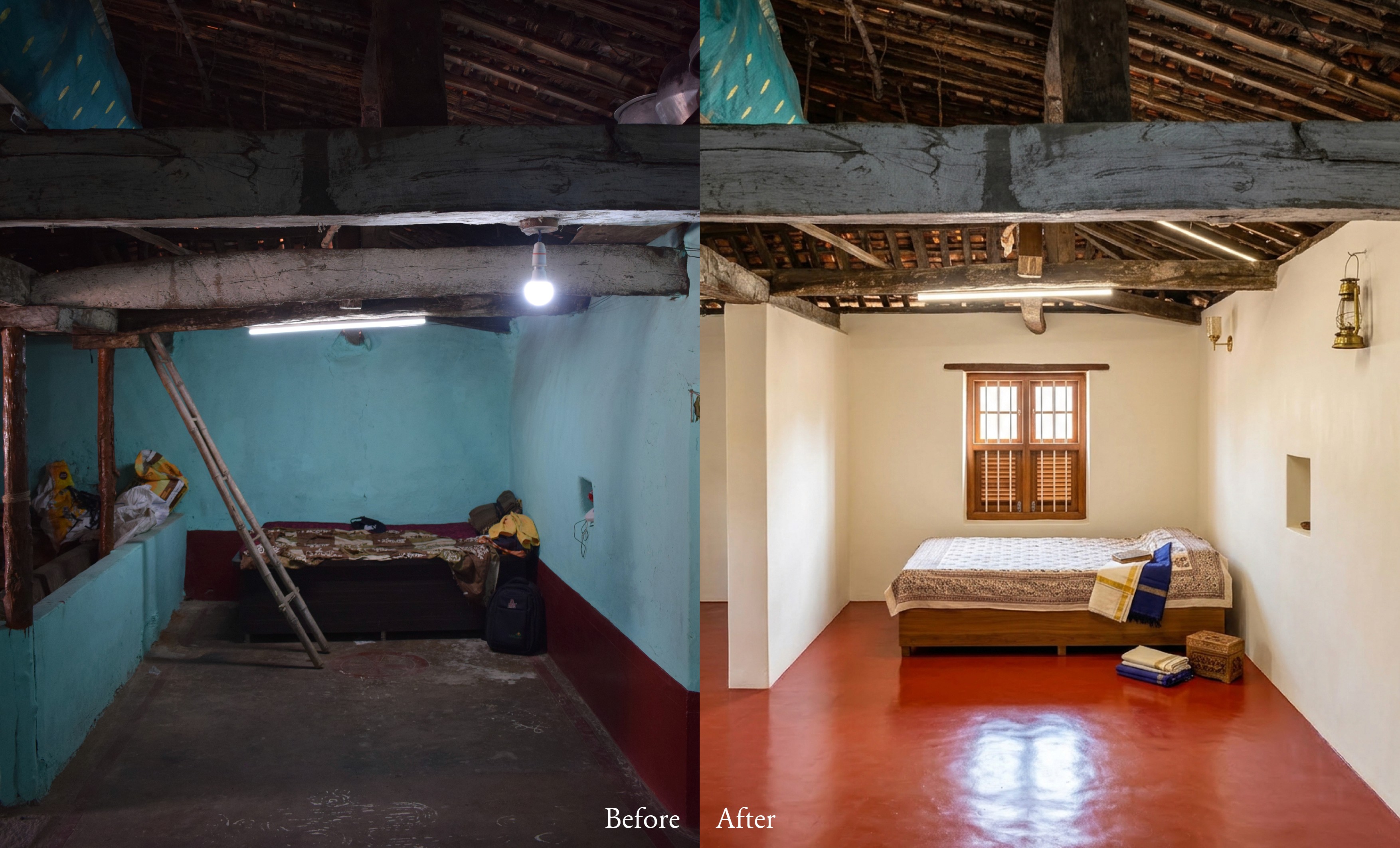
Retrofitting Vernacular. Transformation over demolition

Location: Gram Panchayat Balaghatta, Mandya District, Karnataka
Programme: Residential
Project focus: Transformation of existing vernacular mud houses, known as Thotti Mane, through data-informed, financially-informed, and performance-informed retrofitting
A Crisis of Imagination: Construction represents 25% of India's national CO2 emissions, and NITI Aayog estimates that 80% of India's 2030 building stock has not yet been built, meaning every housing decision made today, whether to demolish or retrofit, will lock in emission trajectories for decades.
Vernacular Knowledge, Undervalued: Thotti Mane mud houses are extremely climate-fit and have existed for decades, some for centuries. Their thick mud walls provide outstanding thermal performance, and central openings allow continuous airflow that keeps the house cool year-round. Yet these homes are often overlooked in favor of new concrete construction.
The Real Cost of "Affordable" Housing: Subsidized concrete housing costs around 10lakhs, far beyond the reach of families earning around 50,000 rupees a year for housing. This gap forces families into debt, financial pressure, and often contributes to distressed migration. Meanwhile, existing mud houses are five times bigger than subsidized concrete alternatives and have already proven their durability over decades.

Retrofitting Over Demolition: Retrofitting is significantly more sustainable than new construction. For Thotti Mane houses, the main vulnerability is the roof, water infiltration is the biggest issue, but one that is easy and affordable to fix compared to full rebuilding.
Proof of Concept: The project targets the transformation of 10 houses to build a data-informed demonstration, evaluated by CSTEP, Karnataka's state policy think tank. Each retrofit is budgeted at 4 lakhs, covering roof reconstruction, plastering, and finishing work.
Filling a Knowledge Gap: The project offers a unique opportunity to monitor and evaluate the multiple performances of Thotti Mane houses in a rigorous, data-informed way. This kind of evidence is currently missing from the international community working on mud architecture and vernacular housing advocacy, making this demonstration a valuable contribution to the field.
Sustainable Livelihoods: The project also demonstrates that sustainable architecture can go hand in hand with sustainable livelihoods, training women, who represent 35% of India's construction workforce, making them highly skilled and well-paid workers.
Part of a Larger Vision: This project is part of a larger initiative, Panchayat of the Future.